
Hip Labral Tear
Our Expertise
Shoulder Injuries
Recurrent Shoulder dislocation
Rotator Cuff Tear
Injuries around Shoulder
Slap Tears
Knee Injuries
ACL Injury
PCL Injury
Meniscus Injury
MPFL/MCL/LCL Injury
Cartilage Injury
Sport Injuries
ATFL Tear
Tennis Elbow
Golfer Elbow
Hip Labrel Tear
Treatment and Procedures
Shoulder Arthroscopy
Shoulder Replacement
Knee Arthroscopy
Knee Replacement
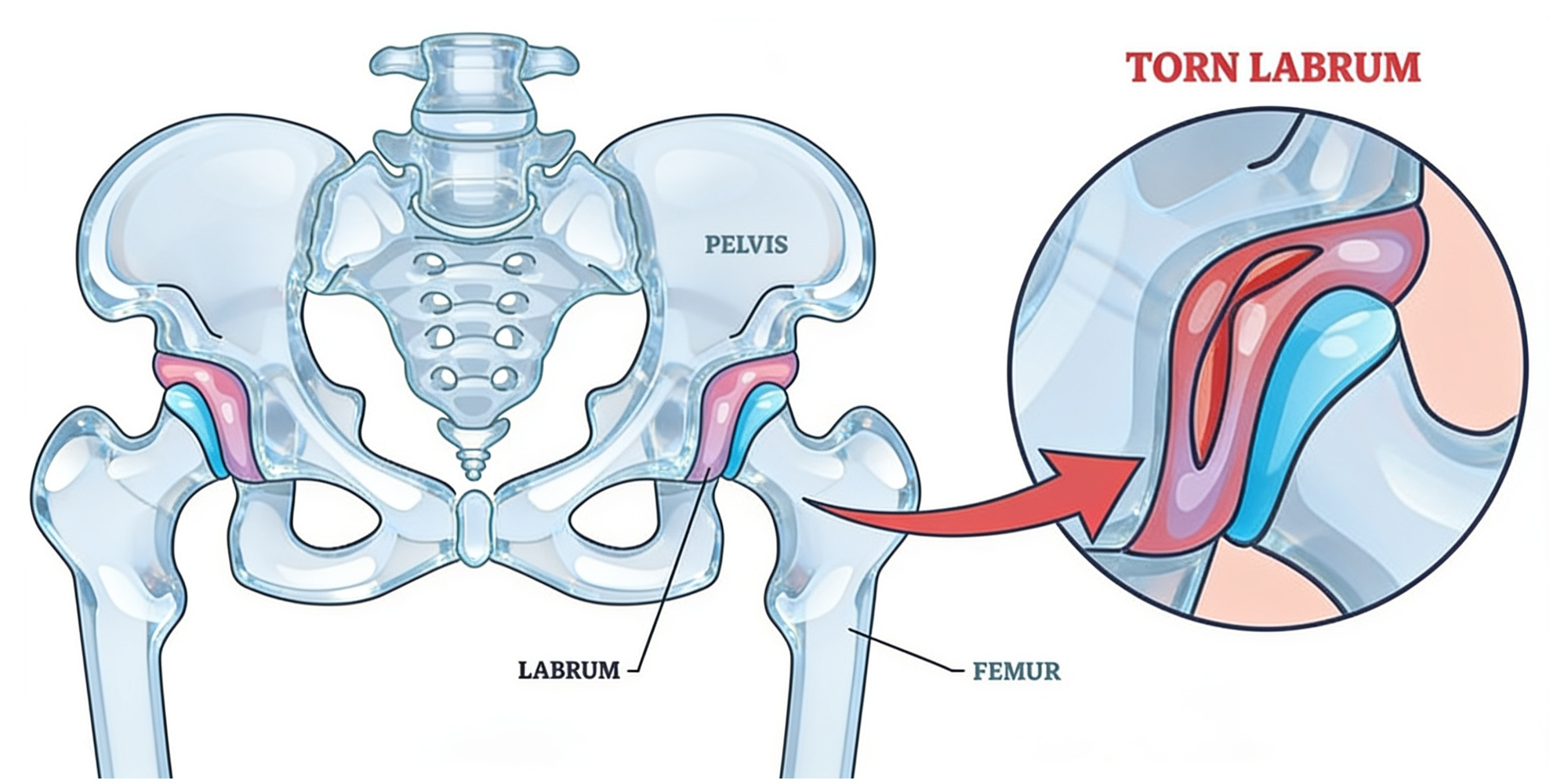
Deep, nagging groin pain that won’t fully go away. A clicking or catching sensation when you rotate your hip. Stiffness after sitting for long periods, or a sharp pinch when you squat too deep. These are classic signs of a hip labral tear — an injury that’s often misdiagnosed as a simple muscle strain, but one that, left untreated, can quietly wear down the hip joint over time.
The labrum is a ring of firm, rubbery cartilage that lines the rim of the hip socket (acetabulum). It deepens the socket, helps hold the ball of the thighbone (femoral head) securely in place, and creates a seal that keeps the joint properly lubricated. When the labrum tears, that stability and cushioning is compromised — and every twist, pivot, or deep bend of the hip can aggravate it further.
At Jaipur Sports Doc, Dr. Abhishek Saxena specializes in accurately diagnosing hip labral tears and building a treatment plan matched to your specific cause, severity, and activity goals — whether that means structured rehabilitation or precise arthroscopic repair.
What Causes a Hip Labral Tear?
Hip labral tears rarely have a single, simple cause. Common contributors include:
- Structural abnormalities — Conditions like femoroacetabular impingement (FAI), where the ball and socket of the hip don’t fit together perfectly, cause repeated friction against the labrum with every movement, gradually wearing it down.
- Repetitive movement — Sports involving frequent hip rotation, pivoting, or extreme ranges of motion — football, cricket, golf, dance, and martial arts — place ongoing stress on the labrum.
- Trauma — A sudden fall, a forceful twist, or a direct blow to the hip during contact sport can tear the labrum in an instant.
- Degeneration — As with other joints, the labrum can weaken and fray naturally with age, making even minor movements enough to cause a tear.
Because several of these factors often overlap, understanding why a tear happened is just as important as treating the tear itself — otherwise, the same problem tends to resurface.
Recognizing the Symptoms
Hip labral tears can be subtle, and symptoms are frequently mistaken for other conditions like hip flexor strain or lower back pain. Watch for:
- Deep pain in the groin or the front of the hip, sometimes radiating to the buttock or thigh
- A clicking, catching, or locking sensation during hip movement
- Stiffness or reduced range of motion, particularly with rotation
- Pain that worsens with prolonged sitting, standing, walking, or sports activity
- A feeling of instability or the hip “giving way” during pivoting movements
Because the hip is deeply seated and surrounded by strong muscles, symptoms can develop gradually and be dismissed for months before a proper diagnosis is made — which is often why labral tears are more advanced by the time patients seek specialist care.
How We Diagnose a Hip Labral Tear
A thorough evaluation starts with understanding your symptom history — when the pain started, what movements aggravate it, and whether there was a specific triggering injury or a gradual onset. This is followed by a focused clinical examination, including specific maneuvers designed to reproduce labral symptoms and assess your hip’s range of motion and stability.
Imaging plays a central role in confirming the diagnosis:
- X-rays help identify underlying structural issues like FAI or early arthritic changes that may be contributing to the tear.
- MRI, often with contrast (MR arthrogram), provides a detailed view of the labrum itself, allowing precise assessment of the tear’s size, location, and any associated cartilage damage.
This combination allows Dr. Saxena to build a complete picture — not just confirming that a tear exists, but understanding the underlying mechanical cause driving it.
Treatment Options
Non-Surgical Management
For mild to moderate tears, especially where symptoms are manageable and there’s no significant underlying structural abnormality, conservative treatment is often the first step:
- Activity modification and rest to reduce irritation of the labrum
- Targeted physical therapy to strengthen the muscles supporting the hip joint, improving stability and reducing the mechanical stress placed on the labrum
- Anti-inflammatory treatment and, in select cases, image-guided injections to reduce pain and inflammation, allowing patients to progress through rehabilitation more comfortably
Many patients see meaningful improvement with this approach alone, particularly when the tear is small and there isn’t significant structural impingement driving ongoing damage.
Hip Arthroscopy
When symptoms persist despite conservative care, or when the tear is significant, arthroscopic surgery offers a minimally invasive solution. Through small incisions, Dr. Saxena can:
- Repair the torn labrum, reattaching it to restore the socket’s natural seal and stability wherever the tissue quality allows
- Debride damaged fragments when the tissue can’t be repaired, relieving mechanical symptoms like catching and locking
- Address underlying structural causes, such as reshaping bone in cases of femoroacetabular impingement, to reduce the risk of future labral damage
Because hip arthroscopy is minimally invasive, patients typically experience less post-operative pain, smaller scars, and a faster return to daily activities compared to open hip surgery.
Recovery and Rehabilitation
Recovery after hip labral tear treatment is a gradual, staged process. Following surgery, most patients use crutches for a short period to protect the repair while healing begins, transitioning into progressive physiotherapy focused on restoring range of motion, rebuilding hip and core strength, and retraining movement patterns to protect the joint going forward. Full return to sport typically takes a few months, guided by steady, measurable progress rather than a fixed timeline alone.
Whether treated surgically or non-surgically, the underlying goal is the same: relieve pain, restore stability, and reduce the mechanical stress that caused the tear in the first place — protecting the hip joint’s long-term health.
A Hip That Keeps Clicking and Catching Won’t Fix Itself
An untreated labral tear can reduce hip stability, speed cartilage wear, and increase the risk of arthritis. If persistent hip pain has been dismissed as a muscle strain, it’s worth getting it properly evaluated.