
Shoulder Dislocation Treatment
Our Expertise
Shoulder Injuries
Recurrent Shoulder dislocation
Rotator Cuff Tear
Injuries around Shoulder
Slap Tears
Knee Injuries
ACL Injury
PCL Injury
Meniscus Injury
MPFL/MCL/LCL Injury
Cartilage Injury
Sport Injuries
ATFL Tear
Tennis Elbow
Golfer Elbow
Hip Labrel Tear
Treatment and Procedures
Shoulder Arthroscopy
Shoulder Replacement
Knee Arthroscopy
Knee Replacement
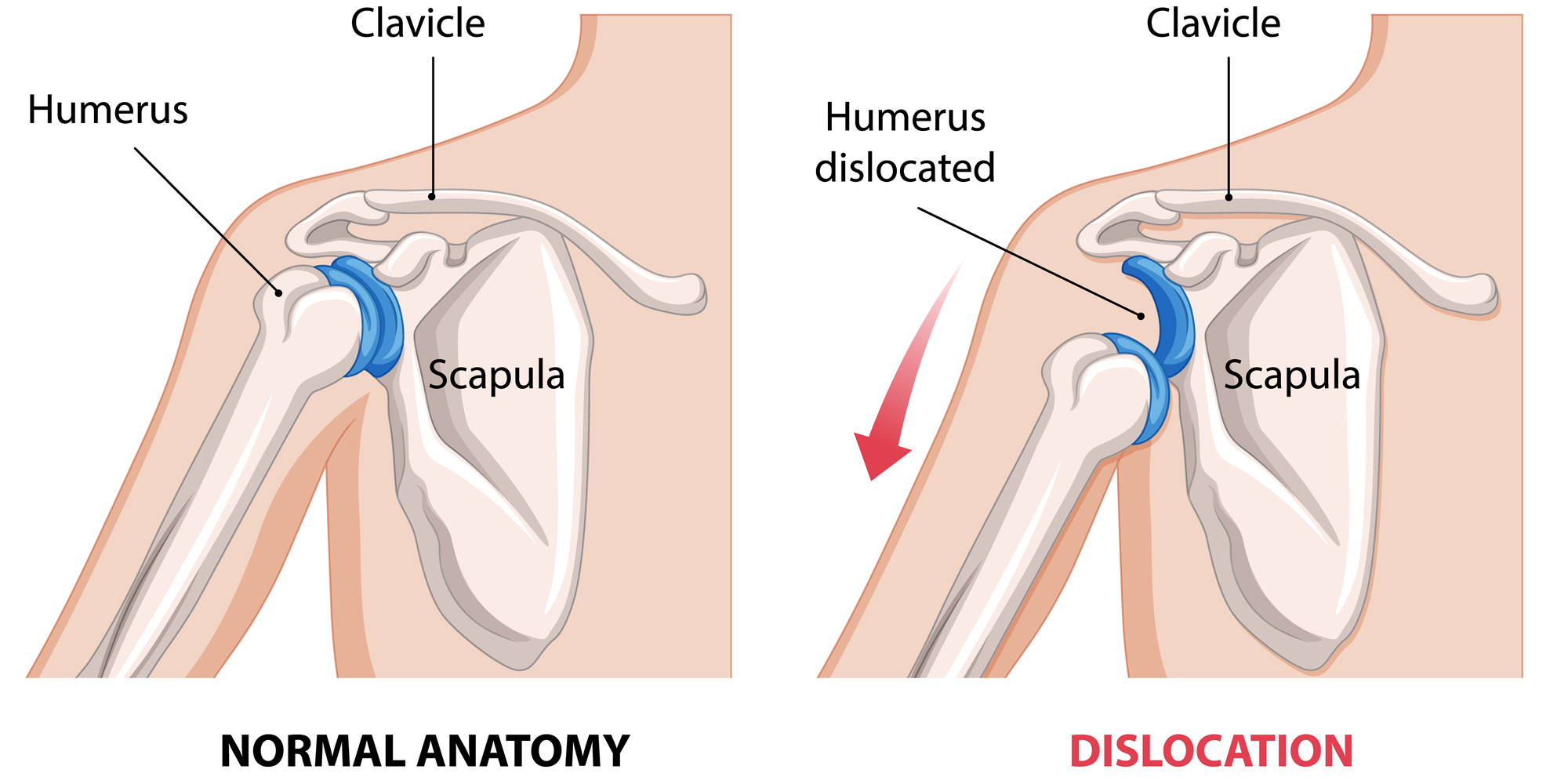
A shoulder dislocation happens when the head of the upper arm bone is forced out of its socket — usually from a fall, a sports collision, or a forceful overhead movement. The first dislocation is often the most painful and dramatic, but it’s rarely the last word: once the shoulder’s stabilizing structures are damaged, the joint is significantly more prone to dislocating again, especially in younger and more athletic patients. Dr. Abhishek Saxena, fellowship-trained in shoulder arthroscopy and sports medicine, evaluates and treats both first-time and recurrent shoulder dislocations, with treatment decisions based on your age, activity level, and the specific damage involved — not a one-size-fits-all protocol.
Understanding Shoulder Dislocation
The shoulder is a ball-and-socket joint, but the “socket” — the glenoid — is shallow, which is what gives the shoulder its exceptional range of motion. That same shallowness is also why the shoulder dislocates more often than any other joint in the body. When the arm bone is forced out of the socket, it typically tears the labrum — the ring of cartilage that helps hold the joint in place — at the front of the shoulder. This specific injury is known as a Bankart lesion, and it’s the underlying reason a first dislocation so often leads to a second, third, or more: once that labral “bumper” is torn, the joint loses a key stabilizing structure. In some cases, the dislocation also chips or compresses the bone itself (a bony Bankart lesion or Hill-Sachs lesion), which further increases instability.
Most shoulder dislocations are anterior (the arm bone slips forward and down out of the socket), though posterior and, rarely, multidirectional dislocations also occur.
What Causes Shoulder Dislocation
Sports trauma — collisions, falls, or a forceful tackle, common in contact sports and overhead sports like cricket, handball, or volleyball
Falling onto an outstretched arm — a common cause outside of sport as well
Repetitive overhead strain — in throwing or racquet sports, gradually loosening the shoulder’s stabilizing structures
Previous dislocation — by far the strongest risk factor for a repeat dislocation; once the labrum is torn, the shoulder is mechanically less stable
Younger age — patients in their teens and twenties have meaningfully higher rates of recurrence after a first dislocation than older patients, largely because of higher activity levels and more elastic tissue
Joint hypermobility or connective tissue laxity — some people are simply more prone to instability across multiple joints
Signs of Shoulder Instability
Acute dislocation (seek immediate care):
- Visibly out-of-place or deformed shoulder
- Severe pain and inability to move the arm
- Swelling and bruising around the joint
Numbness or weakness down the arm
Recurrent instability (book a consultation):
- A repeated feeling that the shoulder is “loose,” “slipping,” or about to give way, especially overhead or behind the body
- Pain or apprehension when reaching back to throw or put on a jacket
- A history of one or more prior dislocations or subluxations (partial dislocations that “popped back in”)
- Avoiding certain movements or sports out of fear the shoulder will slip
How Shoulder Dislocation Is Diagnosed
After an acute dislocation, the immediate priority is putting the joint back in place (reduction) and ruling out associated fracture or nerve injury, usually with an X-ray. Once the acute episode has settled, evaluating why it happened and how likely it is to recur involves a focused clinical exam testing the shoulder’s stability and apprehension in different positions, along with an MRI or MR arthrogram to clearly visualize the labrum, ligaments, and any bone loss — findings that directly shape whether non-surgical management or surgical stabilization is the better path.
Treatment for Shoulder Dislocation
Arthroscopic shoulder stabilization (Bankart repair)
For younger or athletic patients, those with a confirmed Bankart lesion, or anyone who has already had a repeat dislocation, surgical stabilization is typically the more reliable path. Using arthroscopic (keyhole) technique, the torn labrum is reattached to the glenoid using small anchors, restoring the joint’s natural stabilizing “bumper” through small incisions — meaning less post-operative pain and a faster recovery than open surgery. In cases with significant bone loss, additional bone-block procedures may be needed for durable stability.
Non-Surgical Management
For a first-time dislocation — particularly in older or less active patients — a structured physiotherapy program to rebuild strength and stability around the joint is often tried first. This won’t repair a torn labrum, but it can meaningfully improve shoulder control and, in lower-risk patients, may be enough to prevent further episodes.
Immediate Care
A dislocated shoulder needs to be carefully put back into place by a trained professional, followed by a short period of immobilization in a sling to allow initial healing.
Recovery After Shoulder Stabilization Surgery
Recovery follows a staged process: a sling for the first few weeks to protect the repair, followed by progressive physiotherapy that restores range of motion first, then strength, and finally sport-specific movement. Most patients return to daily activities within 6 weeks and to full sport, including contact and overhead sports, in the range of 4 to 6 months — though this varies based on the surgery performed, the sport, and how consistently rehab milestones are met. Rushing back too early is one of the most common preventable causes of re-injury, which is why Dr. Saxena’s rehab plans are milestone-based rather than calendar-based.
FAQ
Will my shoulder dislocate again if I don’t have surgery?
It’s a real risk, particularly if you’re young, active in sport, or have already had more than one dislocation — each dislocation tends to make the joint progressively less stable. This is exactly why a proper evaluation after even a first dislocation matters, rather than just waiting to see what happens.
Do I need surgery after just one dislocation?
Not always — it depends on your age, activity level, and what’s found on imaging. Older, less active patients with a low-risk profile are often managed conservatively first. Younger athletes or anyone with a confirmed Bankart lesion and significant instability risk are often better served by early surgical stabilization, since outcomes tend to be better when surgery isn’t delayed until after multiple dislocations.
How is shoulder dislocation surgery performed?
Most cases are treated arthroscopically — through small incisions using a camera and fine instruments — to reattach the torn labrum to the bone using small suture anchors, restoring the joint’s natural stability without the larger incision open surgery required.
When can I return to sport after stabilization surgery?
Most athletes return to their sport, including contact and overhead sports, around 4 to 6 months after surgery, guided by strength and stability milestones rather than a fixed date.
Can shoulder dislocation be prevented?
You can’t fully eliminate the risk in contact or overhead sports, but maintaining shoulder and scapular strength, using proper technique, and addressing any underlying joint laxity can meaningfully reduce risk — and treating an unstable shoulder properly after a first episode is the best protection against a worsening pattern.
Don’t Wait for the Next Dislocation
Every episode of instability makes the next one more likely. Get an accurate evaluation and a treatment plan built around your activity level and goals.