
Golfer’s Elbow
Our Expertise
Shoulder Injuries
Recurrent Shoulder dislocation
Rotator Cuff Tear
Injuries around Shoulder
Slap Tears
Knee Injuries
ACL Injury
PCL Injury
Meniscus Injury
MPFL/MCL/LCL Injury
Cartilage Injury
Sport Injuries
ATFL Tear
Tennis Elbow
Golfer Elbow
Hip Labrel Tear
Treatment and Procedures
Shoulder Arthroscopy
Shoulder Replacement
Knee Arthroscopy
Knee Replacement
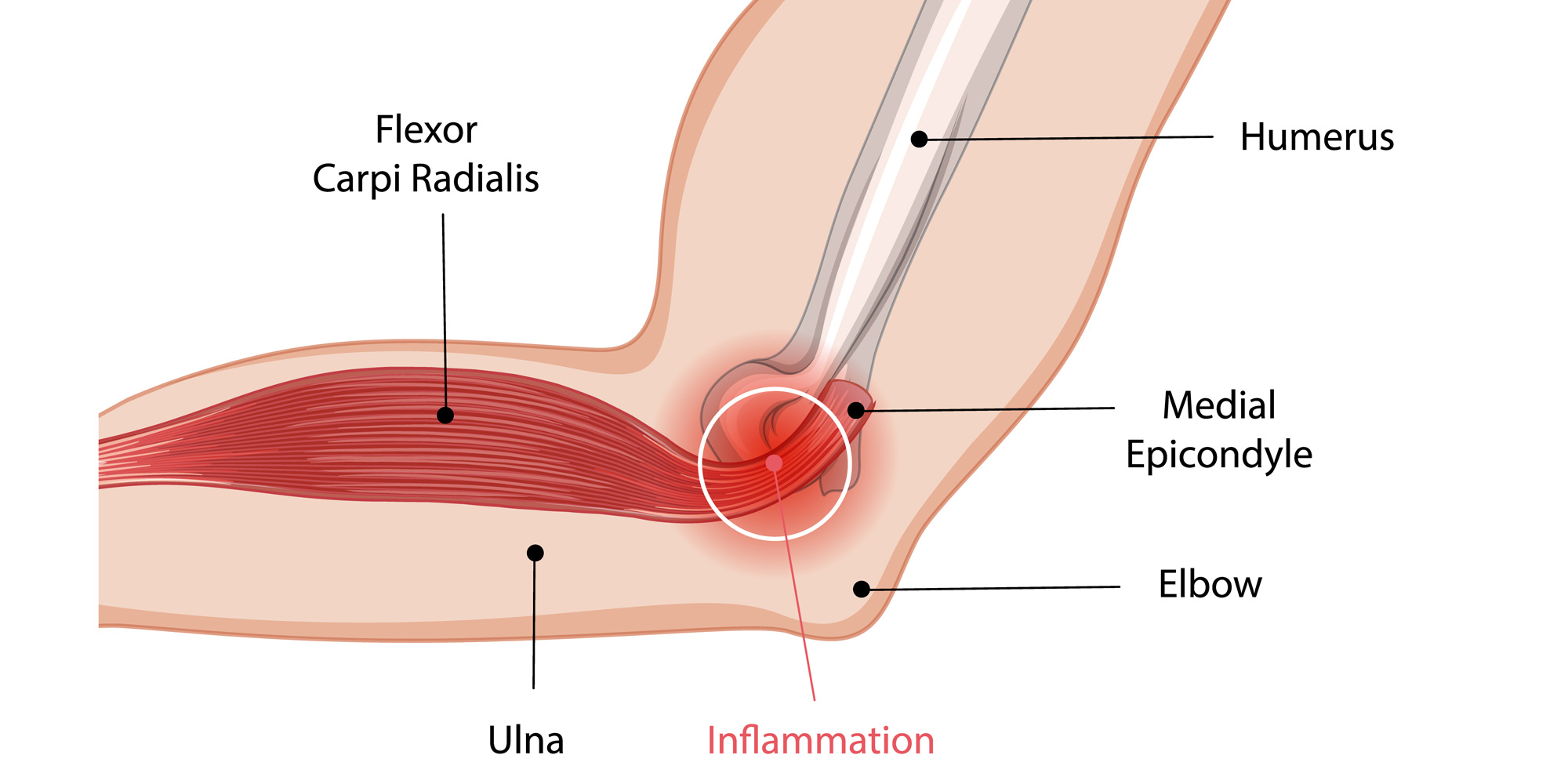
Golfer’s elbow, medically known as medial epicondylitis, is a condition that causes pain, tenderness, and inflammation on the inner side of the elbow, where the forearm’s flexor tendons attach to a bony bump called the medial epicondyle. Despite the name, it isn’t limited to golfers — it’s just as common in tennis players, weightlifters, carpenters, painters, and anyone whose daily activities involve repeated gripping, wrist flexion, or forearm rotation.
The condition develops from cumulative overuse rather than a single injury. Small, repetitive strain on the flexor-pronator tendons — the group of muscles that bend the wrist and rotate the forearm — gradually causes microscopic tears and degeneration at the tendon’s attachment point. Over time, this leads to the persistent inner-elbow pain that makes even simple tasks like shaking hands, turning a doorknob, or lifting a coffee cup uncomfortable.
At Jaipur Sports Doc, Dr. Abhishek Saxena brings a sports-medicine approach to golfer’s elbow — treating not just the pain, but the underlying mechanical and biomechanical factors that caused it, so the problem doesn’t simply return once you’re back to your sport or work.
What Causes Golfer’s Elbow?
- Repetitive gripping and wrist flexion — common in golf, tennis (particularly topspin-heavy strokes), weightlifting, and rock climbing
- Occupational overuse — carpentry, plumbing, painting, and assembly-line work that involve repeated forceful hand and wrist motion
- Poor technique or equipment — an incorrect golf swing, an overly tight grip, or ill-fitted equipment can place excess strain on the flexor tendons
- Sudden increase in activity — ramping up training intensity or frequency without adequate conditioning
- Age-related tendon changes — tendons naturally lose some elasticity and blood supply with age, making them more vulnerable to overuse injury, typically between ages 40 and 60
Recognizing the Symptoms
Golfer’s elbow tends to develop gradually, and symptoms can be easy to dismiss at first. Watch for:
- Pain and tenderness on the inner side of the elbow, sometimes radiating down the forearm
- Stiffness in the elbow, particularly first thing in the morning
- Weakness in the hand and wrist, especially when gripping objects
- Pain that worsens with wrist flexion, forearm rotation, or making a fist
- A tingling or numbness sensation that may extend into the ring and little fingers, if nearby nerves are irritated
If left unaddressed, these symptoms can progress from a minor ache during activity to constant pain that interferes with everyday tasks.
How Golfer’s Elbow Is Diagnosed
Diagnosis usually begins with a detailed history — what activities trigger the pain, how it started, and how it has progressed — followed by a focused physical examination. Dr. Saxena will test resisted wrist flexion and forearm rotation, and palpate the medial epicondyle directly, since reproducing the pain at this specific site is often enough to confirm the diagnosis.
In cases where the diagnosis is unclear, or symptoms are more severe or long-standing, imaging may be used to rule out other causes and assess the extent of tendon damage:
- Ultrasound — a quick, effective way to visualize tendon thickening, tearing, or degeneration in real time
- MRI — provides a more detailed view of the tendon and surrounding structures, particularly useful when surgery is being considered or when nerve involvement is suspected
This step matters because inner-elbow pain isn’t always golfer’s elbow — ulnar nerve irritation, cervical spine referral, and elbow joint pathology can all mimic its symptoms, and each requires a different treatment approach.
Treatment Options
Conservative Treatment — Effective for the Vast Majority of Patients
Most cases of golfer’s elbow respond well to non-surgical management, particularly when addressed early:
- Rest and activity modification to reduce ongoing strain on the tendon while it heals
- Ice application to control pain and inflammation in the acute phase
- Anti-inflammatory medication for short-term symptom relief
- Structured physiotherapy, focused on stretching and progressively strengthening the flexor-pronator muscle group, which is the single most important factor in both recovery and preventing recurrence
- Bracing or a counterforce strap, worn just below the elbow, to redistribute load away from the injured tendon during activity
- Corrective coaching, particularly for golfers and tennis players, to address the grip, swing mechanics, or technique that contributed to the injury in the first place
Injection Therapy
For patients whose pain persists despite several weeks of conservative care, targeted injections — including corticosteroid or platelet-rich plasma (PRP) injections — can help settle inflammation and support the tendon’s natural healing response, allowing rehabilitation to progress more comfortably.
Minimally Invasive Surgery
Surgery is reserved for the small percentage of patients whose symptoms don’t improve after 6–12 months of dedicated conservative treatment, or where imaging shows significant tendon tearing. Modern minimally invasive techniques allow the damaged, degenerated portion of the tendon to be debrided and repaired through small incisions, with the goal of restoring healthy tendon attachment and relieving pain — while minimizing scarring and shortening recovery compared to traditional open surgery.
Recovery and Getting Back to Your Sport
Recovery timelines depend on severity and treatment path. Mild cases managed with rest, bracing, and physiotherapy often improve significantly within 4–6 weeks. More persistent cases, or those requiring injection therapy, may take two to three months of consistent rehabilitation before symptoms fully resolve.
For patients who undergo surgery, recovery is more gradual — typically involving a period of splinting or bracing, followed by a structured physiotherapy program to restore strength and flexibility, with a full return to sport or heavy manual work generally expected within three to six months.
Throughout recovery, the emphasis isn’t just on eliminating pain — it’s on correcting the technique, grip, or repetitive movement pattern that caused the problem, so you can return to golf, sport, or work with meaningfully lower risk of it coming back.
Why Choose Dr. Abhishek Saxena for Golfer’s Elbow
- Personalized care built around your specific sport, activity level, and daily demands — not a generic protocol
- Advanced diagnostic imaging to accurately assess tendon damage and rule out other causes of elbow pain
- A strong preference for effective non-surgical treatment, with minimally invasive surgical options available when genuinely needed
- Rehabilitation guidance that addresses the root mechanical cause, aimed at long-term prevention, not just short-term relief
Golfer’s Elbow Rarely Gets Better on Its Own — Especially If You Keep Playing Through It
The longer the flexor tendon is repeatedly loaded without proper treatment, the more the underlying degeneration builds up — turning a manageable case of tendon irritation into a chronic problem that’s harder to reverse. If your grip is weaker, your swing hurts, or the ache in your inner elbow hasn’t settled in a few weeks, that’s the time to get it assessed.