
Injuries Around Shoulder
Our Expertise
Shoulder Injuries
Recurrent Shoulder dislocation
Rotator Cuff Tear
Injuries around Shoulder
Slap Tears
Knee Injuries
ACL Injury
PCL Injury
Meniscus Injury
MPFL/MCL/LCL Injury
Cartilage Injury
Sport Injuries
ATFL Tear
Tennis Elbow
Golfer Elbow
Hip Labrel Tear
Treatment and Procedures
Shoulder Arthroscopy
Shoulder Replacement
Knee Arthroscopy
Knee Replacement
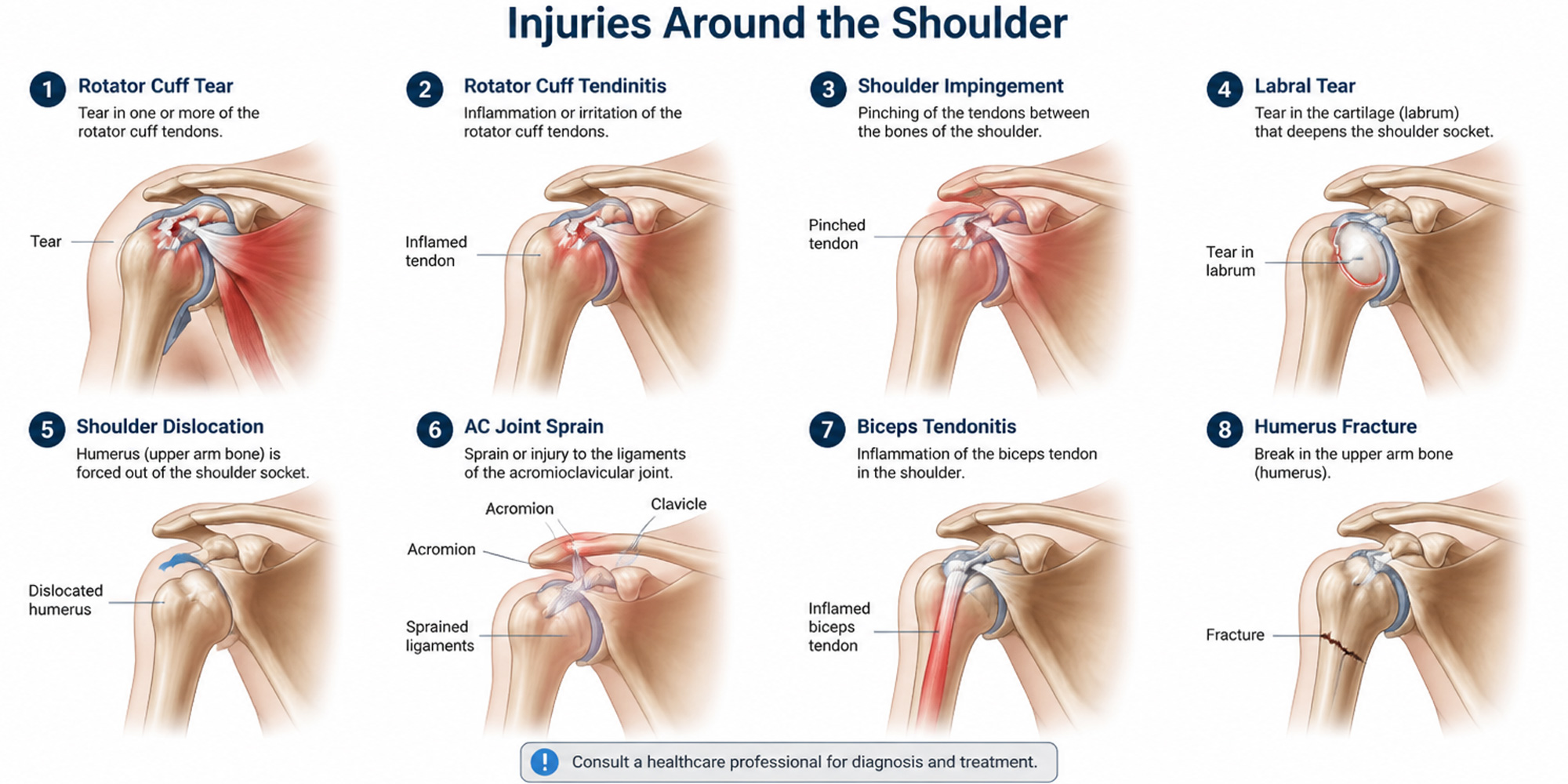
Shoulder pain doesn’t always come from a torn ligament or tendon. Conditions like frozen shoulder, shoulder impingement, and AC joint injuries have entirely different causes and require different treatment approaches — yet they’re commonly mistaken for each other, or for a rotator cuff tear, because the symptoms can overlap. Dr. Abhishek Saxena, fellowship-trained in shoulder arthroscopy and sports medicine, evaluates the specific structures involved to make sure you get the right diagnosis and the right treatment from the start.
Frozen Shoulder (Adhesive Capsulitis)
Treatment
Most cases are managed without surgery: physiotherapy to maintain and gradually improve range of motion, anti-inflammatory medication, and corticosteroid injections, which can be particularly effective earlier in the freezing stage. Procedures such as hydrodilatation (a controlled fluid injection to stretch the tightened capsule) can help in select cases. Surgery — typically arthroscopic capsular release — is reserved for patients whose stiffness doesn’t sufficiently improve with conservative treatment over an adequate trial period.
Who it affects
Frozen shoulder is most common between the ages of 40 and 60, more frequently in women, and is significantly more likely in people with diabetes. It can also develop after a period of shoulder immobility — following surgery, a fracture, or even prolonged disuse from another injury.
What it is
Frozen shoulder occurs when the capsule surrounding the shoulder joint thickens and tightens, progressively restricting movement. Unlike most shoulder injuries, it isn’t caused by a specific tear or trauma — it develops gradually, often for reasons that aren’t fully understood, and follows a pattern most patients aren’t expecting: it tends to get worse before it gets better, over a long timeline.
Treatment
Frozen shoulder occurs when the capsule surrounding the shoulder joint thickens and tightens, progressively restricting movement. Unlike most shoulder injuries, it isn’t caused by a specific tear or trauma — it develops gradually, often for reasons that aren’t fully understood, and follows a pattern most patients aren’t expecting: it tends to get worse before it gets better, over a long timeline.
AC Joint Injury (Shoulder Separation)
Treatment
Most AC joint injuries (Grade I–II) heal well with a sling, activity modification, and physiotherapy, with most patients returning to sport within a few weeks. Higher-grade separations (Grade III and above), especially in younger or competitive athletes, are more often considered for surgical stabilization to reconstruct the torn ligaments and restore normal joint mechanics and shoulder strength.
Symptoms
Pain directly on top of the shoulder at the joint, swelling, and in more severe tears, a visible bump or step-off where the collarbone sits higher than normal. Pain typically worsens when reaching across the body or lifting the arm.
Grading
AC joint injuries are graded by severity, from mild sprains with the ligaments intact (Grade I–II) to a complete tear of the supporting ligaments (Grade III), through to more severe injury patterns involving surrounding muscle attachments (Grade IV–VI). Lower-grade injuries are generally managed without surgery; higher-grade injuries, particularly in athletes or younger patients, are more likely to need surgical stabilization.
Treatmen
The acromioclavicular (AC) joint is where the collarbone meets the tip of the shoulder blade. A direct fall onto the shoulder or a collision — common in contact sports, cycling, and martial arts — can sprain or tear the ligaments holding this joint together, commonly called a “shoulder separation.”
Getting the Right Diagnosis
Frozen shoulder, shoulder impingement, AC joint injury, and rotator cuff tears can all cause pain with overhead movement — which is exactly why self-diagnosis (or treating every shoulder pain the same way) often leads nowhere. Dr. Saxena’s evaluation combines a focused clinical exam testing specific movements and joint stability with imaging where needed — X-ray to check the AC joint and bone, MRI or ultrasound to assess soft tissue and capsule changes — to identify precisely which structure is involved before recommending treatment.
FAQ
How is frozen shoulder different from a rotator cuff tear?
A rotator cuff tear typically causes weakness along with pain, especially with specific movements, while frozen shoulder causes a more global stiffness and loss of motion in all directions, often without significant weakness. The two can still be confused without a proper exam, and frozen shoulders can sometimes occur alongside a cuff problem.
How long does frozen shoulder take to go away?
The full course, from the start of stiffness to near-complete recovery, often runs 12 months or longer, though pain typically improves well before full range of motion returns. Early treatment in the freezing stage can meaningfully shorten how long the painful phase lasts.
Does shoulder impingement always need surgery?
No — the large majority of impingement cases improve with physiotherapy and activity modification. Surgery is considered only when a clear structural cause is identified and conservative treatment hasn’t worked after a genuine trial period.
I fell directly on my shoulder and now there’s a visible bump — what is that?
That’s a common sign of a higher-grade AC joint separation, where the ligaments holding the collarbone in place have torn, allowing it to sit higher than normal. This should be evaluated promptly to determine the grade of injury and whether surgery is needed.
Can I still exercise with a frozen shoulder?
Gentle, guided range-of-motion exercises are usually encouraged and form the core of treatment — but pushing through sharp pain or self-directed aggressive stretching can sometimes aggravate the condition, which is why a structured, supervised physiotherapy plan works better than guessing on your own.
Get the Right Diagnosis, Not a Guess
Shoulder pain has many possible causes, and the right treatment depends on getting the right one identified. Book a consultation with Dr. Saxena.